Overview
Update note: Added progress tracking, adoption templates, and clearer language about checking current docs.
This course uses the OpenAI Academy Codex for Builders material as a foundation, then expands it into a practical operating guide for a broad audience: business users, team leads, analysts, project managers, product owners, technical program managers, developers, and curious first-time Codex users.
The Academy resource describes Codex as a software teammate for builders. This guide uses that as the starting point, not the limit. It adds current Codex concepts from the Codex manual and practical business scenarios so you can see how Codex can help with development, code review, desktop-guided work, browser tasks, email and message analysis, document drafting, spreadsheet analysis, presentation creation, planning, problem resolution, and parallel research when the right tools, files, approved app connections, and permissions are available.
You do not need to be a software engineer to benefit from this course. The course explains technical terms as they appear, uses business examples, and shows you how to ask Codex for plans, drafts, analysis, validation, and evidence. Advanced details are still here for learners who need them, but the flow is designed so a motivated general business user can follow it step by step.
Codex Operating Model
Treat Codex work as a simple loop, not just a casual chat. Start with a clear business intent. Let Codex do supervised work. Review the evidence. Then make a human decision. Click each part below to see how it fits this training.
Business IntentDefine the outcome, value, risk, and boundaries.
Business intent connects a real business need to the work Codex can do. A weak request says, "fix this," "summarize these," or "make a deck." A stronger request explains why the work matters, who will use the result, what needs protection, what limits apply, and what decision the output should support.
In this course, business intent helps you delegate clearly. Name the desired outcome, relevant context, constraints, quality bar, time horizon, and decision owner. In software work, that might be a feature, bug, migration, or pull request. In knowledge work, it might be a client-ready brief, meeting summary, email response draft, variance analysis, or executive presentation.
- Outcome: What should be different after the work is complete?
- Audience: Who will consume or approve the output?
- Context: Which files, emails, chats, tickets, spreadsheets, screenshots, policies, or systems matter?
- Constraints: What should Codex avoid, preserve, comply with, or escalate?
- Done criteria: What evidence proves the output is ready for review?
Codex WorkPlan, inspect, reason, draft, edit, run, compare, and coordinate.
Codex work is the supervised work phase. Depending on the tools and permissions available, Codex may inspect a repository, review files, analyze email exports, compare spreadsheets, browse a web app, draft a document, create a presentation, run checks, or coordinate parallel subtasks. The key is simple: keep the work in a defined scope and ask Codex to report what it did.
Codex is not only for coding. It can also help with work where reasoning, source material, tools, and clear outputs matter. You might ask one thread to analyze customer emails, another to build a slide outline, and another to inspect a spreadsheet. Parallel work is useful when ownership is clear and someone reconciles the outputs before acting.
- Planning: Ask Codex to clarify ambiguous work before acting.
- Inspection: Have Codex identify source material and summarize what it found.
- Execution: Let Codex draft, edit, analyze, test, or prepare outputs within the agreed scope.
- Coordination: Use parallel work only for independent tasks with non-conflicting outputs.
- Escalation: Require Codex to stop when it hits sensitive data, unclear authority, or risky actions.
EvidenceMake the work inspectable, traceable, and reviewable.
Evidence is what separates useful guided project work from unverified output. In code, evidence may include tests, diffs, logs, screenshots, or reproduction steps. In business work, evidence may include cited source emails, spreadsheet calculations, source file names, assumptions, comparison tables, decision logs, or a summary of what was excluded.
This training uses evidence as a core habit. Codex should not simply provide an answer. It should show enough of its path that a knowledgeable person can review the result. Evidence also helps identify hallucinations, missing context, bad assumptions, and overreach before a draft becomes an action.
- Traceability: Which sources informed the result?
- Verification: What checks, calculations, tests, or comparisons were performed?
- Limits: What was not checked, unavailable, ambiguous, or assumed?
- Outputs: What file, draft, deck, workbook, diff, or summary was produced?
- Review focus: Which risks should the human reviewer inspect first?
DecisionAccept, revise, escalate, delegate more, or publish.
The decision phase belongs to the accountable human or team. Codex may recommend next steps, but it should not quietly send emails, publish documents, merge code, delete records, or make commitments unless the user has explicitly authorized that action and the environment permits it.
In this course, you practice turning Codex output into decisions. You might accept a pull request, request revisions, approve a draft email, ask for deeper analysis, create a presentation for leadership, or escalate a compliance question. The decision should reference the business intent and evidence, not just how polished the response sounds.
- Accept: The output meets intent and evidence requirements.
- Revise: The direction is useful, but assumptions, tone, format, or details need work.
- Escalate: Risk, authority, data sensitivity, or policy questions require a human owner.
- Delegate more: A new scoped task can be assigned based on what was learned.
- Publish or act: Only after explicit approval for outbound or production-impacting actions.
What You Will Be Able To Do
- Explain Codex in business terms: what it does, where it fits, and when it should not be used without oversight.
- Choose the right place to use Codex for a task: app, CLI, IDE, web/cloud, iOS, or GitHub review.
- Write strong prompts using goal, context, constraints, and done criteria.
- Evaluate Codex output through tests, diffs, review evidence, and risk controls.
- Recognize non-development workflows where Codex-style agents can summarize, analyze, draft, compare, prepare, or coordinate work.
- Use team guidance such as
AGENTS.md to make behavior more consistent.
- Design a practical adoption plan with training, safety controls, metrics, and escalation paths.
- Watch separate simulations that demonstrate goal-to-deliverable workflows, then run hands-on Codex practice labs in a learner-controlled environment.
Course Structure
This course is designed for serious knowledge workers and first-time Codex users who want practical understanding, not just a quick tour. You do not need advanced technical training. You should be comfortable reading instructions, asking questions, reviewing evidence, and thinking carefully about business risk, but the course explains the operating concepts as it goes.
The Academy ladder now appears as its own set of sections. Codex 101 covers onboarding and first safe use. Codex 102 covers practical workflows such as CLI, IDE, GitHub review, skills, MCP, and reusable guidance. Codex 103 covers advanced workflows, automation, subagents, worktrees, and governed scaling. After that ladder, the detailed course sections explain the same concepts by operating area: Codex role, where Codex fits, prompting, verification, security, team guidance, adoption, playbook use, and broader work-assistant patterns. Simulations now come before Practice Labs so you can first watch an end-to-end workflow, then try the pattern in your own Codex environment.
Each section assessment gives immediate feedback after each answer. The explanation tells you why the correct answer is right and why the alternatives are weaker or unsafe. The final assessment draws from all sections and randomizes order each time it opens. The goal is not academic grading. The goal is readiness: can you frame work, supervise Codex, inspect evidence, and make responsible decisions?
Organizational Readiness Templates
The templates below turn the course from reading material into an adoption tool. Use them before letting a team apply Codex to live work. They are deliberately short enough to complete in a meeting, but specific enough to expose weak ownership, unclear data boundaries, missing evidence expectations, and risky automation assumptions.
Pilot Charter Template
Codex Pilot Charter
Business goal:
Target workflow:
Pilot owner:
Codex operators:
Reviewers and approvers:
Approved places to use Codex:
Allowed data categories:
Prohibited data categories:
Actions that require approval:
Evidence required before acceptance:
Success measures:
Stop or rollback conditions:
Date for pilot review decision:
Workflow Readiness Checklist
Workflow Readiness Checklist
[ ] The workflow has a named business owner.
[ ] The intended output has a clear audience and decision use.
[ ] Source materials are approved for Codex use.
[ ] Confidential or restricted data has been removed or authorized.
[ ] The learner knows where to use Codex and why.
[ ] Approval rules are defined before work begins.
[ ] Required evidence is named before execution.
[ ] A human reviewer is assigned.
[ ] The workflow has a safe first prompt.
[ ] The team knows what Codex must not do.
Evidence And Decision Record
Evidence And Decision Record
Original request:
Business intent:
Sources inspected:
Codex actions performed:
Outputs produced:
Validation performed:
Assumptions:
Open questions:
Risks or policy issues:
Reviewer decision:
Approved follow-up:
Actions not approved:
After-Action Review Template
Codex After-Action Review
Workflow attempted:
What worked:
What failed or slowed the work:
Prompt improvements:
Source material improvements:
Safety or approval gaps:
Evidence gaps:
Reusable instructions to create:
Training updates needed:
Decision: expand, revise, pause, or stop:
Sample AI Use Policy Starter
Codex AI Use Policy Starter
Approved workflows:
Prohibited workflows:
Allowed data categories:
Restricted data categories:
Approved places to use Codex:
Required human approvals:
Outbound actions that are blocked by default:
Evidence required before acceptance:
Escalation contacts:
Audit or recordkeeping expectations:
Review frequency for this policy:
Risk Assessment Worksheet
Codex Risk Assessment
Workflow name:
Business value:
Data sensitivity: low / moderate / high
External system access: none / read-only / write-capable
Potential harm if wrong:
Human reviewer:
Required evidence:
Approval gate:
Rollback or correction path:
Residual risk:
Decision: approve pilot / revise / reject:
IT Readiness Checklist
IT Readiness Checklist
[ ] Approved installation path is defined.
[ ] Account and identity requirements are clear.
[ ] Network, proxy, and endpoint controls are understood.
[ ] Data-loss prevention expectations are documented.
[ ] GitHub, repository, or approved app connection access is approved.
[ ] Browser or computer-use permissions are defined.
[ ] Logging and evidence expectations are documented.
[ ] Support owner is named.
[ ] Update and version-review process is defined.
[ ] Deprovisioning process is defined.
Adoption Case Study Starters
Case 1: Weekly Project Status
Situation: A program manager spends hours consolidating issue updates, meeting notes, and decision requests.
Codex use: Codex prepares a draft status summary from approved source files, separates facts from assumptions, and flags decisions needed.
Review standard: The manager verifies owners, dates, blockers, and source evidence before anything is sent.
Case 2: Support Trend Analysis
Situation: A support leader needs to understand whether a complaint spike is product, process, or communication related.
Codex use: Codex analyzes sanitized exports, clusters themes, creates an evidence matrix, and drafts an executive summary.
Review standard: The analyst checks calculations, sample bias, missing data, and whether any customer details must be redacted.
Case 3: Small Internal Tool
Situation: Operations needs a simple browser-based helper to summarize a CSV without sending the file to a vendor system.
Codex use: Codex turns requirements into a local HTML prototype, adds validation rules, and produces a testing checklist.
Review standard: The owner confirms local-only behavior, tests sample files, and approves use only for non-sensitive data until policy allows more.
Professional Reasoning Standard
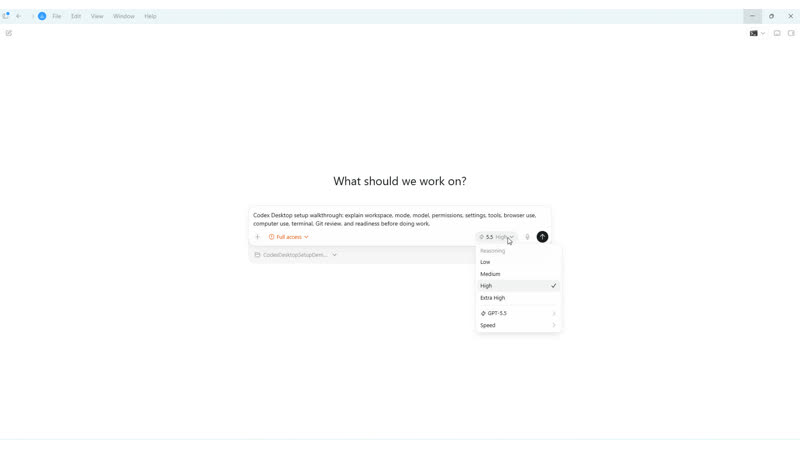
For real work, use the strongest approved Codex reasoning mode available, especially when a task has unclear requirements, multiple files, business risk, data analysis, security review, or leadership-facing outputs. Current OpenAI Codex guidance recommends gpt-5.5 for most demanding Codex work. If your account or organization exposes different plan labels or reasoning controls, use the strongest approved option shown in your current Codex model selector or official documentation rather than guessing a model ID.
The practical rule is simple: routine drafting can use faster modes, but work that affects business decisions, customer commitments, production systems, confidential data, or leadership outputs needs stronger reasoning, human review, evidence, and explicit approval for important actions.
Suggested Learning Paths
The paths below are shortcuts, not rigid tracks. Use the path that matches your responsibility. Executives and sponsors usually need business value, decision, and safety context. Operators, analysts, project leads, and developers usually need more hands-on practice. Simulations help when you want to see a workflow before doing it; they are optional for senior sponsors.
| Learner Type | Recommended Path | What To Skip Or Treat As Optional | Why This Path Fits |
|---|
| Executive sponsor or senior leader | Overview, First-Time User if a product walk-through is needed, Codex 101 role framing, Codex 102 security concepts, and Codex 103 adoption or final readiness questions selected by the implementation team. | Skip hands-on practice labs, detailed CLI/IDE mechanics, and most workflow simulations. Sponsors may watch the Codex Desktop Basic Setup simulation only if they need a quick orientation to what operators see in the desktop app. | This learner decides whether Codex should be funded, governed, piloted, expanded, or paused. The practical focus is business value, platform fit, risk appetite, accountable ownership, evidence expectations, adoption metrics, and escalation paths. |
| Business process owner or general business user | Overview, First-Time User, Codex 101 role and prompting, Codex 102 verification basics, Codex 103 work-assistant examples, Simulation 1, and selected practice labs. | Codex 102 workflow simulations are optional previews if the learner has not yet seen Codex work end to end. Skip developer-heavy labs unless the role owns technical workflows. | This learner needs to understand where Codex fits, frame practical business work, provide safe source material, review drafts, require traceability, and decide whether an output is usable, needs revision, or must be escalated. |
| Project manager, product owner, or team lead | Overview, First-Time User, Codex 101 surface selection and prompting, Codex 102 verification and workflow simulations, and Codex 103 adoption and playbook content. | Use Codex 102 workflow simulations only as previews before hands-on labs or reviewer walkthroughs. Skip deep Team Guidance unless this learner owns team standards. | This learner turns ambiguous requests into clear work, manages sequencing, coordinates people and tools, asks for validation notes, and communicates decisions back to reviewers. |
| Analyst, operations user, or reporting owner | Overview, First-Time User, Codex 101 prompting, Codex 102 verification and hands-on practice labs, and Codex 103 work-assistant content. | Codex 102 workflow simulations and practice labs are optional previews. Skip Security beyond data-handling basics unless the learner manages sensitive workflows or policy controls. | This learner benefits most from source-backed analysis, spreadsheet interpretation, recurring status work, evidence tables, and business recommendations that can be reviewed. |
| Developer, technical reviewer, or technical program manager | Where Codex Fits, Prompting, Verification, Security, Team Guidance, Playbook, Practice Labs 4, 5, 6, and 7. | Simulation 1 is useful for first-time desktop setup; Simulations 5 through 8 are optional workflow orientation. Experienced technical learners should move quickly into repository-backed practice and evidence review. | This learner needs the technical operating model: IDE, CLI, GitHub review, repository instructions, tests, diffs, migrations, defect resolution, and controlled implementation. |
| Security, compliance, or platform owner | Prerequisites, Where Codex Fits, Verification, Security, Team Guidance, Adoption, selected Playbook templates, and a review of Practice Lab setup requirements. | Skip most simulations unless they are being used to evaluate control points. Do not start with hands-on labs unless the goal is to review the learner environment. | This learner defines access boundaries, approval rules, data-handling requirements, audit expectations, model availability, reasoning-mode policy, reusable instructions, and rollout controls. |
How To Use The OpenAI Guide
The OpenAI Academy guide is treated here as a validation source and companion guide, not as the full curriculum and not as a limit on what can be taught. It gives the official high-level framing: what Codex is, where it can be used, which builder workflows it supports, how it connects to ChatGPT plans, why GPT-5-Codex matters for guided coding, and which core resources are recommended. This course expands those points with current Codex manual concepts, business examples, safety and approval patterns, practical prompts, evidence rubrics, simulation labs, and non-development use cases.
When this course goes beyond the Academy guide, it does so intentionally: to make Codex easier to understand, to show practical business uses, and to include current capabilities and operating patterns that may not be fully covered in the Academy resource.
Coverage Map
| OpenAI Guide Topic | Course Coverage | Practice And Simulation Coverage | Expansion Added Here |
|---|
| Codex 101 Introduction and Onboarding | Overview, First-Time User, and Codex 101 | Codex 101 introduces safe setup, first workspace choice, inspect-first prompting, beginner simulation, beginner practice lab, and level assessment. | What Codex is, how it relates to ChatGPT/OpenAI access, safe first use, workspace boundaries, and first reviewable output. |
| What Codex is | Overview, First-Time User, and Codex 101 | Simulation 1 introduces Codex Desktop setup; later simulations show Codex as a supervised teammate that moves from goal to deliverable; practice labs let learners try delegation in their own environment. | Supervised delegation, human accountability, business value, limits, role boundaries, and when Codex should stop for review. |
| Where Codex can be used | First-Time User prerequisites and Codex 101 surface selection | Practice environment setup covers desktop/app, CLI, and IDE paths; Codex 102 workflow simulations show setup and tool selection in context. | Selection guidance for app, CLI, IDE, web/cloud, GitHub, browser, computer use, approved app connections, and business-tool workflows. |
| Builder use cases | Sections 1, 4, 8, and 9 | Practice Labs 4 through 7 cover small tool creation, debugging, migration, and review; Simulations 5 through 8 demonstrate the same workflows end to end. | Codebase familiarization, docs, debugging, migrations, feature work, advanced automation, review, knowledge work, and parallel execution. |
| ChatGPT plan connection | Prerequisites, Section 5, and Section 7 | Practice setup asks learners to confirm approved access before using real data; safety-focused simulations show approval gates and rollout controls. | Access planning, organizational enablement, role-based rollout, data policy questions, and adoption readiness. |
| GPT-5-Codex model guidance | Sections 1, 3, and 4 | Simulations repeatedly model adaptive planning, requirement extraction, implementation, validation, and evidence; assessments test the judgment behind those steps. | How steerability, deeper reasoning, review strength, image or UI context, and verification habits affect real workflows. |
| Key benefits for builders | Sections 3, 4, 8, and 9 | Every practice lab includes prompt patterns; simulations show how raw input becomes structured prompts, requirements, and deliverables. | Work orders, done criteria, assumptions, stop conditions, evidence requests, tone control, and prompt repair. |
| Evidence, testing, and review | Section 4 and Section 8 | Practice Labs require tests, calculations, citations, screenshots, diffs, or review notes; simulations end with an evidence-backed HTML deliverable. | Evidence ladder, traceability, validation checklists, residual risk notes, and decision readiness. |
| Codex demo | Sections 2, 4, 6, and 8 | Simulation 1 covers desktop setup orientation; Simulations 5, 6, and 8 turn demo concepts into observable tool-building, defect-fixing, and pull-request-review workflows. | IDE extension, Codex web, and code review are treated as connected operating patterns rather than isolated product features. |
| Codex 102 Practical Workflows and workshop preview | Codex 102, Verification, Security, Team Guidance, Workflow Simulations, and Hands-On Practice Labs | Codex 102 now holds the practical CLI, IDE, GitHub review, MCP, skills, reusable guidance, simulation, practice lab, and level assessment material. | Team instructions, AGENTS.md, skills, MCP setup concepts, tool-connection basics, reusable prompts, review patterns, and practical evidence habits. |
| Codex 103 Advanced Workflows and Automation | Codex 103, Adoption, Playbook, Work Assistant, and Final Assessment | Codex 103 now holds advanced automation, subagents, worktrees, multi-agent review, governance, simulation, practice lab, and level assessment material. | Long-horizon work, parallel review, role agents, automation readiness, governance, approval gates, and scale controls. |
| Non-development and business productivity applications | Section 9 plus Practice Labs and Simulations | Practice Labs 2, 3, 8, 9, and 10 and Simulations 3, 4, 9, 10, and 11 cover analysis, documents, presentations, workflow inspection, and parallel business analysis. | Email/message analysis, spreadsheets, executive narratives, recurring status, workflow friction, decision packages, and governed automation ideas. |
| Core resources and next steps | All sections and final assessment | Reference links appear in relevant sections; the final assessment checks Academy material, Codex manual concepts, simulations, and practical operating judgment. | Linked references are used as validation sources while the course adds detailed examples, role paths, exercises, simulations, and adoption controls. |
Reference Links
Quality And Governance Evidence
This guide includes audit artifacts so course owners can review the quality standard, demo contract, and current validation results. These documents are part of the training governance record. They separate what has been produced and verified from anything that still needs true video production or later maintenance.
- Commercial training quality review summarizes the section-level quality pass, commercial-grade expectations, and residual limits.
- Training quality audit records the automated structural checks for sections, tabs, assessments, references, media, image alt text, and terminology.
- Demo logic audit documents the verified First-Time User video demo and the walkthrough items that must not be described as video demos.
- Demo contract governance defines the rule that a demo must be a real recorded video or comparable live capture, not a text walkthrough or slide sequence.
- Production smoke test report records the latest live-site tab, media, image, layout, and demo/walkthrough validation run.
OpenAI Academy Section Links